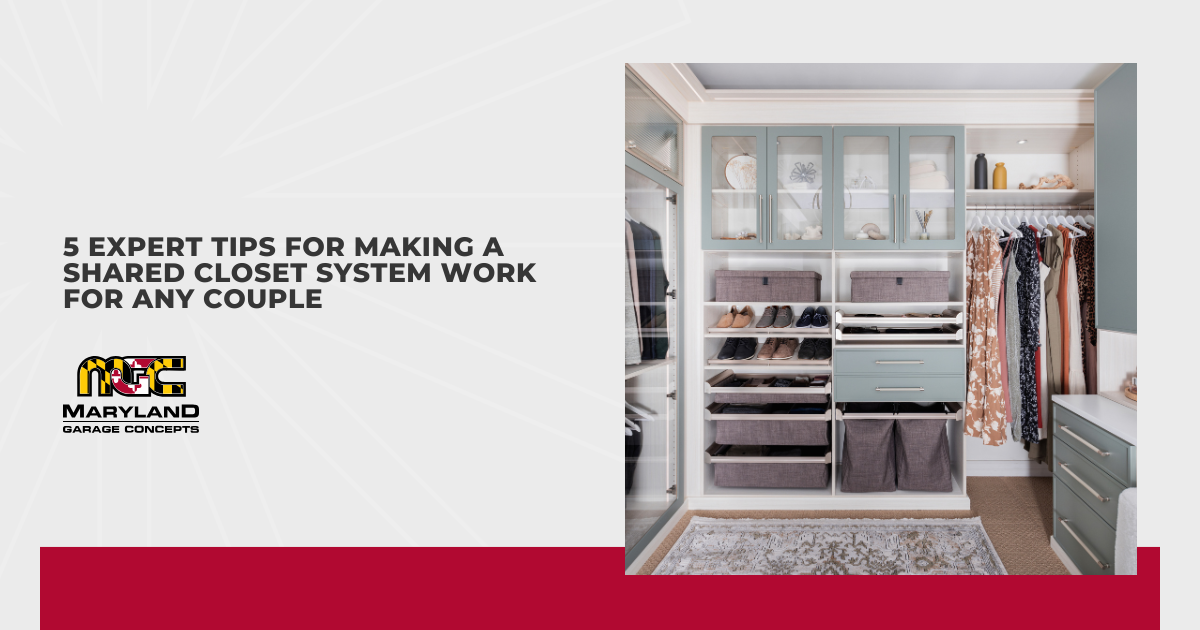

5 Expert Tips for Making a Shared Closet System Work for Any Couple
Dennis Quintero • June 11, 2026

5 Expert Tips for Making a Shared Closet System Work for Any Couple

If your shared closet system could talk, it would probably say something like: "I belong to whoever got here first." One person's shoes are slowly taking over the floor, the other's jackets have somehow claimed three-quarters of the hanging space, and nobody's quite sure how it got to this point. In my experience, this almost never comes down to how much space is available. Making it work for both of you isn't a myth. It just requires a little more intention than "we'll figure it out as we go."


Turns out, making a shared closet work has nothing to do with how much space you have or how tidy you are. Compromise only gets you so far when the closet was never designed with two people in mind. If you and your partner have been tiptoeing around each other's sections for years, the problem isn't you. It's the layout.


Here's what it actually takes to make a shared closet system work for both of you:


  • Start with an honest conversation
  • Divide the space intentionally
  • Customize each person's section
  • Build in shared storage
  • Keep it flexible


Pull all five together and the result is a shared closet that neither of you will want to mess up.


Start With an Honest Conversation

Before a single shelf is moved or a zone is assigned, the two of you need to sit down and talk about what you actually need from the shared closet. Most couples skip this step entirely and dive straight into reorganizing, which is exactly why the system falls apart within a few weeks. A conversation about storage needs, daily habits, and wardrobe size sounds simple, but it surfaces details that make a real difference in how the closet gets designed. How much hanging space does each person need? Who has more shoes? Who needs drawer space for folded items and who prefers to hang everything?


Honesty matters here more than politeness. If one person has significantly more clothing than the other, acknowledging that upfront means the layout can be divided accordingly rather than splitting the space down the middle and calling it fair. Talking through how each person gets ready in the morning also helps identify which items need to be most accessible and which can live in harder-to-reach sections. A few minutes of honest conversation at the start saves a lot of renegotiation down the road.


It's also worth talking about what hasn't been working in the current setup. If one person is constantly frustrated by a lack of drawer space and the other keeps running out of hanging room, those are specific problems that a new layout can solve. Knowing exactly what's been driving each person crazy makes it much easier to design a closet system that addresses both sets of frustrations rather than just reshuffling the same problems. Think of this conversation as the foundation everything else gets built on.

Divide the Space Intentionally

Once you both know what you need, the next step is dividing the closet in a way that actually reflects those needs rather than just splitting it down the middle. An equal split sounds fair, but it rarely is, because two people almost never have identical storage requirements. One person might need significantly more hanging space while the other needs more drawers and shelving. Dividing based on what each person actually owns and uses is what makes the layout feel fair rather than just symmetrical.


Start by mapping out the full closet space and assigning sections based on the conversation you had in the previous step. Hanging sections, drawer banks, shoe storage, and shelving should all be allocated based on who needs what rather than who got which side of the room. Clear physical boundaries between each person's section are worth building into the design itself, as a visual divider or a dedicated column of shelving makes it obvious where one person's space ends and the other's begins. Boundaries that are built in rather than agreed upon verbally are the ones that actually hold up over time.


Avoid the temptation to leave any section of the closet as shared or undefined, as ambiguous space almost always gets claimed by whoever needs it most in the moment. Every inch of the closet should have a clear owner, and any genuinely shared items should have their own designated section rather than floating between the two zones. A layout with no gray areas is one that stays organized without requiring constant policing.


Customize Each Person's Section

Once the space has been divided, the real work begins: designing each person's section around their specific wardrobe and daily habits. Two people sharing a closet rarely need the same configuration, and treating their sections as mirror images is one of the most common mistakes in shared closet design. Someone with a lot of dresses and long coats needs a full-length hanging section, while someone who mostly wears shirts needs double hang space and deeper drawers. Getting the configuration right for each person is what makes their section feel like it was built specifically for them.


Shelf heights, drawer depths, and hanging rod placement should all be tailored to what's actually going inside each section. A person with an extensive shoe collection needs more dedicated shoe storage than someone with a handful of pairs. Jewelry drawers, valet rods, and accessory hooks are all features worth considering based on each person's specific needs rather than adding them uniformly across both sections. The goal is for each person to feel like their side of the closet was designed with them in mind.


Customization is also what prevents one person's section from feeling like an afterthought compared to the other's. In my view, a shared closet only truly works when both people feel equally considered in the design, not just spatially but functionally. Walking into a section built around your wardrobe and your routine is a completely different experience from making do with whatever was left over.

Build in Shared Storage

Not everything in a shared closet belongs to one person, and leaving that reality unplanned is what leads to items drifting into whoever's section has the most room. Designating a clearly defined shared zone within the closet system gives those items a home that belongs to both of you without encroaching on either person's individual space.


  • Luggage and travel gear: Suitcases, travel bags, and carry-ons stored together mean neither person has to raid the other's space when a trip comes up.
  • Seasonal clothing: Out-of-season items for both people in one shared section keeps seasonal overflow from spilling into everyday hanging and shelf space.
  • Extra bedding and linens: Spare blankets, pillowcases, and sheets stored here free up space in both individual zones without competing for real estate in either person's section.
  • Household overflow: Items without a natural home elsewhere, like spare toiletries or infrequently used accessories, are better consolidated here than scattered across both zones.
  • Accessories used by both: Shared scarves, umbrellas, or other items either person might reach for deserve a neutral spot that belongs to neither zone specifically.

A clearly defined shared section keeps the rest of the closet cleaner and prevents the slow territorial creep that happens when communal items don't have a designated home.

Keep It Flexible

Two people sharing a closet means two sets of needs, two wardrobes, and two daily routines that are constantly evolving. A layout that doesn't account for that from the start will eventually stop working, no matter how well it was designed. After working with many couples on their shared closets, I’ve noticed that the ones that hold up best over time are almost always the ones that were designed with some flexibility built in from the start. Modular closet systems are worth prioritizing for exactly this reason, as they allow shelves, hanging rods, and drawer units to be repositioned as your needs shift.


A seasonal review of your shared closet is a habit worth building into your routine, separate from any decluttering you already do. Look at what's working, what's getting ignored, and where frustration points have crept back in. Small adjustments made together twice a year are far less disruptive than a full reorganization every few years. Treating your closet as something that evolves with your relationship is what keeps it functional long term.


Flexibility also means being willing to revisit the original division of space as your circumstances change. If one person's wardrobe has grown or a new hobby has introduced a category of items that didn't exist before, your layout should be able to accommodate that. A shared closet that can grow and change with both of you is one that continues to work without becoming a source of renewed conflict. The couples who maintain the best shared closets treat the layout as a living agreement rather than a permanent settlement.


ConclusioN

Tension over a shared closet almost always disappears when the space was designed with both of you in mind from the start. You don't need a bigger closet or a complete renovation to get there. A few intentional decisions about how the space is divided, customized, and maintained are often all it takes. Put in the thought upfront and you might be surprised by how much smoother your mornings get when the closet finally works for both of you.

Share this article

Recent Posts

How a Custom Garage Storage System Can Transform Your Home
By Dennis Quintero April 7, 2026
Investing in garage organization not only improves functionality but also enhances your overall living environment. Read on to learn more!

Why Professional Garage Organization Beats DIY Every Time
By Dennis Quintero March 12, 2026
Looking to declutter your space? Garage organization experts create efficient, customized storage solutions that save time and enhance your home’s value.
Garage Organization: Common Mistakes Homeowners Make
By Dennis Quintero January 30, 2026
Maryland Garage Concepts shares garage organization tips: skip common mistakes, improve safety, and reclaim space for a clean garage.
Creative Garage Shelving Ideas for Small Spaces
By Dennis Quintero December 17, 2025
A cluttered garage can quickly feel overwhelming, especially when square footage is limited. At Maryland Garage Concepts, small garages are one of the most common challenges homeowners face, which is why smart garage shelving solutions are essential.
Garage Organization Ideas for Smarter, Clutter-Free Spaces
By Dennis Quintero November 24, 2025
Discover garage organization ideas that create smarter, clutter-free spaces. Learn how Maryland Garage Concepts transforms garages into efficient, usable areas.
Boost Your Home’s Value with These Garage Upgrades
By Dennis Quintero October 31, 2025
Your garage is a key part of your home that can significantly increase its value when upgraded thoughtfully.